
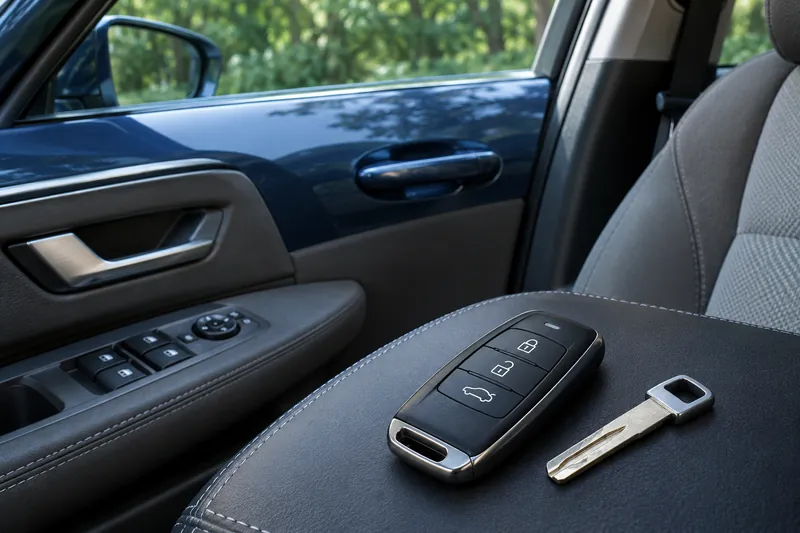

Choose the request, not a guess about the fault
If the keys are inside the vehicle, say so. Entry may be the immediate request. If there is no usable key, the conversation also needs to cover a suitable replacement and any required programming.
A remote button that does not unlock a door is not, by itself, proof that the entire key needs replacing. Likewise, a car that will not start may have a problem beyond its key. An assessment should follow the actual behavior rather than the appearance of the fob.
Keep the year, make and model available. A working key, if there is one, can help distinguish making a spare from an all-keys-lost request. Support must be checked for that vehicle; confirm support for your year, make and model before arranging the work.
What a supplied fob changes
Buying a fob online does not confirm that it can be used. The case may look familiar while the electronics or specification differ. Keep the product information and any part number so compatibility can be discussed before treating it as ready to program.
Our replacement-key explanation separates the blade, starting function and remote functions. A quote should make clear which result is included, rather than describing all of them simply as a key.
A dealer and a locksmith may offer different options for the particular model. Ask about supported work and the full result before deciding whether a tow or a visit is necessary.
The parked location is part of the job
At Concord Mills, the store you visited may be on another side of the property from the car. At Charlotte Motor Speedway, use the actual event lot or marked location. Those venue names help orient a request, but they do not establish parking or service-entry permission.
For a downtown deck or a multi-lot site, use the local parking guide. There is no need to turn the request into a long directions script: use the few details that identify the vehicle's actual position.